Sunday, June 18, 2023

Corruption in America

Born in 1938, I grew up in an era when the New York Times, the “grey lady”, was the reliable paper of record, whose reporting was generally considered accurate and relatively unbiased, as was the nightly newscast by Walter Cronkite, and the model of an FBI agent was Elliot Ness, straight-arrow and un-bribable. There have always been conspiracy theories around that claimed the world was run by this or that cabal, and there were always a few nuts on the fringes that believe in things like the Protocols of the Elders of Zion, that originally-Russian antisemitic fabrication from 1903 that somehow still circulates today. But in general my generation believed that the US government was essentially benign, if occasional inept, and that most things one reads in the newspapers and hears on the nightly TV news were reasonably accurate.

My naivete was first challenged during the Goldwater campaign in 1964. I was in graduate school at Indiana University when Goldwater came to the campus to make a campaign speech, and I attended the event. Before the event a large, quiet, orderly crowd, mostly supportive of Goldwater, gathered, and I was in that crowd. And then I went in and heard the speech live. Imagine my surprise when the evening TV news showed only an agitated group of half a dozen protesters carrying signs that the news crews had found somewhere on the fringes of the crowd (I never saw them), and portrayed the whole event as a violent protest against Goldwater. And then I read the New York Times coverage of the speech. They printed the speech accurately, but they also printed part of the question and answer session afterward, and to my amazement they had transposed part of the answers from some questions to other questions, to make Goldwater look crazy. That was an uncomfortable eye-opener for me.

Over the ensuing years I have gained a more realistic – some might say cynical – view of the world. Nixon and the Watergate affair, Daniel Ellsberg and the Pentagon Papers affair, including particularly the illegal government actions to try to discredit him (which is why the government case against him was thrown out by the judge – he was never prosecuted for leaking the secret report), and even more recently the revelation of widespread secret surveillance of Americans revealed by Edward Snowden before he fled to Russia, among other events, have all contributed to this “more realistic, or more cynical” view of the world.  But I still never bought into the more extreme views of people like Noam Chomsky or Edward Herman, or that are peddled by QAnon.

True, I have always understood basic truths, such as that those in power will always do what they can to maintain their power and protect their wealth and privileges, that corporations exist primarily to make money and may not be too concerned about ethical matters, that the Peter Principles really do operate (people tend to rise to their level of incompetence, and as a consequence over time many upper-level positions in an organization tend to get filled by people who have reached their Peter Principle level), that it is career-limiting to embarrass your boss in public, and that there are always a few bad apples in any barrel. But I never really thought that there was a coordinated “cabal” or “regime” or “deep state” somewhere in a smoke-filled room pulling the strings. But I am beginning to wonder now if I am still naïve.

It’s hard to identify when this worry began to nag at me. Perhaps it was when I realized that in the end no one was ever prosecuted for the excesses of the 2008 subprime crisis so wonderfully and entertainingly explained by the 2015 movie The Big Short. Or perhaps it was when I learned that some traders actually were paid million-dollar bonuses out of the TARP taxpayer money supposedly used to bail out the failing banks. (If you didn’t know, Citigroup, which received $45 billion in government money to bail it out, then gave 738 of its executives bonuses of at least $1 million. Bank of America, which also received a government bailout of $45 billion, paid 172  bonuses at least $1 million, while Merrill Lynch, eventually acquired by Bank of America in a distress sale, doled out 696 bonuses of at least $1 million to its executives.)

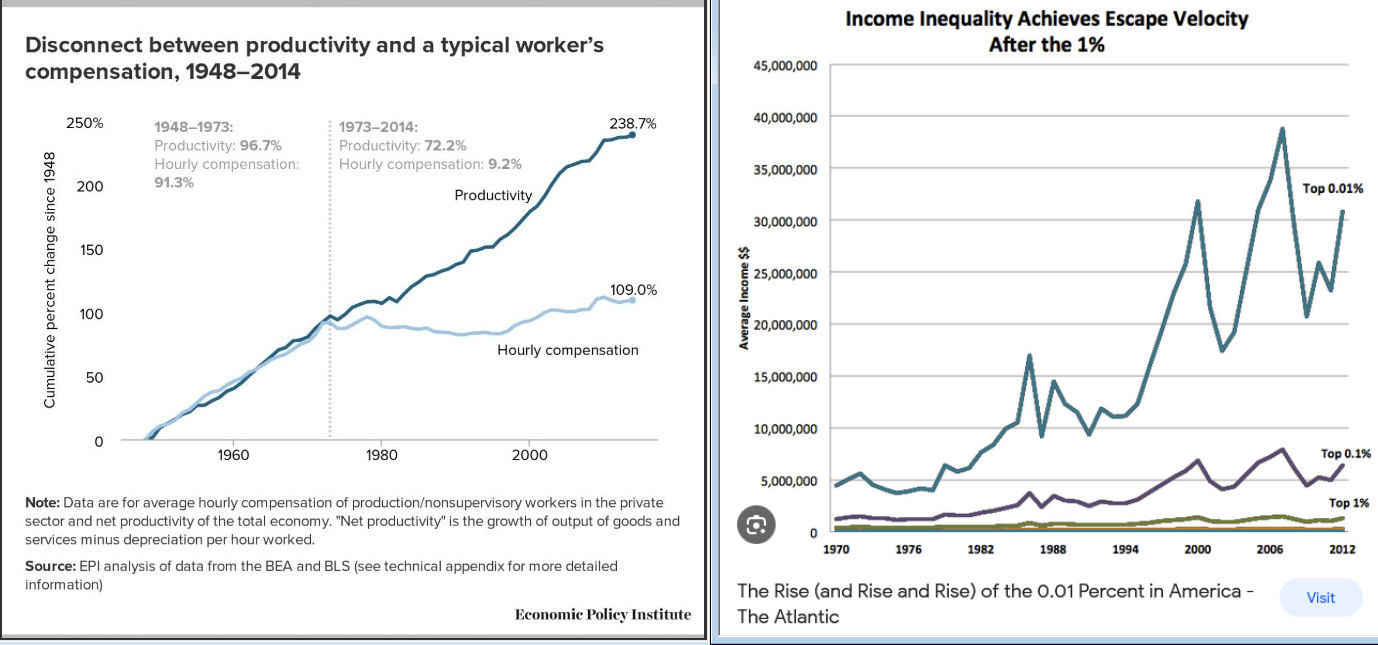
Or perhaps my concern was triggered by a YouTube lecture by Mark Blyth, professor at Brown University and author of Angrynomics, about inequality in America (you can see it here. It runs about an hour and a half). It’s technical economics, but Mark with his Scottish accent is entertaining enough to make it palatable, and the message is important, so it is worth working through this lecture – even re-watching parts if necessary. The two charts that really got my attention are below (the left chart shows that after 1970 productivity increases didn’t mean wage increase. So where did all the money, roughly $1.8 trillion, from the productivity increases go? The right chart shows where – mostly to the top 0.01%, the billionaires.) And how did this happen? Cozy deals that tailored legislation to favor capital over labor, and probably some questionable private deals.


Or perhaps it was when I read Sarah Chayes 2020 book On Corruption in America: And What Is at Stake. Chayes, a journalist, studied corruption in Afghanistan where she lived for some years, and was not surprised when the wildly corrupt government collapsed in a matter of days. She sees the same pattern of corruption in America, though with a slightly different style. For those who don’t read much, see her 50-minute talk about her new book Everybody Knows: Corruption in America. It is very good, and can be seen here.

What Cheyes sees in America is not the sinister secret cabal headed by an evil mastermind like some QAnon conspiracy theories, or like SPECTRE in the James Bond movies. What she saw in Afghanistan and Nigeria and Egypt and some other countries she studied was a pervasive business model – business as usual - in which all the participants - government, military, financial, legal, the underworld – supported each other and got their cut. She describes it as like the Hydra in Greek mythology – many heads working independently, not necessarily coordinating their efforts, but all working toward the same underlying goal. And like the Hydra, cut off a head and two more grow back in its place.

What she sees in America is much the same model, kind of an old-boys network (though there are women in it too now) of people who went to the same schools or clerked for the same judge or were on the board of the same company or worked at the same law firm or somehow were part of the same “elite” group, who “help” each other. She describes it as an extensive network rather than a hierarchical organization. And the corruption in America is more “genteel”. Generally not money delivered in paper bags, but generous campaign donations from a corporation in return for favorable legislation, cushy lobbying jobs on K street for retired members of Congress who were “helpful” to this or that industry, lucrative vice-president positions at Lockeed-Martin or Boeing for “helpful” retired military people. Perhaps the extensive and expensive trips billionaire Harlan Crow gave to Supreme Court justice Clarence Thomas over the past 20 years fits this pattern. Most of it is not illegal, but it is pervasive. People really ought to read her book – I can’t describe it as well as she does.     

Two other books I found unsettling are Dark Money: The Hidden History of the Billionaires Behind the Rise of the Radical Right by New Yorker writer Jane Mayer, and Democracy in Chains: The Deep History of the Radical Right’s Stealth Plan for America, by Duke University historian Nancy MacLean. These are unsettling not so much because of the radical right associations, though that is disturbing enough in itself. They are unsettling in the way they outline the extensive interlocking and incestuous networks across Congress, the government bureaucracy, NGOs (non-government organizations), corporations, law firms, financial institutions, academia, and even the underworld. And there are left-wing equivalents: George Soros, Eli Broad, Jon Stryker and Dirk Ziff among others. As Sarah Cheyes says, they may be on opposite sides on some issues, right vs left, Democrat vs Republican, but they nevertheless work toward a common goal – private control of the nation and its wealth.

Or perhaps my concern was created by the obvious media bias during the Trump administration. Trump is a nasty piece of work, to be sure. But during his years in office two things were clear: (1) the mainstream media spun everything they could against him, trumpeting all the investigations but suppressing revelations that undercut their preferred narrative, and yet (2) gave him ample air time, which he used very effectively to keep his base energized. And then there was social media, blocking accounts selectively to support a preferred narrative or suppress uncomfortable revelations (for example, Facebook has blocked several New York Post articles, one that revealed uncomfortable financial dealings by one of the Black Lives Matter leaders, one that explored the theory that COVID originated in a Chinese lab, and most famously, a series of articles about the uncomfortable (to Democrats) contents of Hunter Biden’s laptop.)    

As I said before, I have generally ignored the writings of people like Noam Chomsky or Edward Herman, seeing them as fringe extremist figures. That may have been a mistake. After reading Chayes book, I went back and read their 2002 book Manufactured Consent: The Political Economy of the Mass Media, and Chomsky’s 2017 book Requiem for the American Dream: the 10 Principles of Concentration of Wealth and Power. I still find their writing style annoys me, but nevertheless I think they may have valid arguments, and I should have paid attention to them earlier.

Sarah Chayes most recent book is titled Everyone knows: Corruption in America. And it’s true. At some level we all do know. We all know the super rich pay almost no taxes, often keeping much of their wealth hidden in off-shore shell companies. We all know corporations buy favorable legislation from Congress and state legislatures. We all know politician these days are generally backed by big-money benefactors, who expect something in return for their generous campaign donations. We all know the media and social media platforms are owned by very rich people, who control the “spin” their platforms put on the news. We all know the rich and powerful get special treatment everywhere – from banks, from the legal system, from corporations, etc. etc.

What I didn’t know until now was how intertwined all of these things were – how it is all an extensive network in which everyone gets their cut, all aimed at the single purpose of harvesting much of the nation’s wealth into a few hands. And I didn’t realize how long-range the planning has been, for example to set up law schools years ago to train a generation of lawyers with the right “judicial outlook” to favor corporations and the wealthy. Or to set up and fund various charity or educational “fronts” to push policy initiative favorable to the wealthy – a step worthy of the Russian KGB.

But if one thinks about it for a moment, how else could the 0.01% manage to capture such a huge amount of the nation’s wealth? It could only be done by a very extensive network working together – legislatures, lawyers, judges, bankers, corporations, and perhaps even a few underworld figures, all getting paybacks for their part.

I think perhaps I have been naïve. I’m not absolutely sure yet, but more and more I think so. And if Sarah Chayes is right, this does not bode well for our nation.   

Sunday, October 30, 2022

Harvard and the Supreme Court

The Supreme Court is hearing arguments this week for Students for Fair Admissions Inc. v. President & Fellows of Harvard College, and a similar case against North Carolina State. The issues are (1) whether the Supreme Court should overrule Grutter v. Bollinger and hold that institutions of higher education cannot use race as a factor in admissions; and (2) whether Harvard College is violating Title VI of the Civil Rights Act by penalizing Asian American applicants, engaging in racial balancing, overemphasizing race and rejecting workable race-neutral alternatives.

It is not the job of the court to determine if affirmative action is desirable, though there is robust public debate on that issue. Nor is it the court’s job to determine if affirmative action is effective, though again there is much public debate about that. The courts only job is to determine if it is legal in the context of the constitution and current federal law.  

Here is the exact text of Title IX:

 “No person in the United States shall, on the ground of race, color, or national origin, be excluded from participation in, be denied the benefits of, or be subjected to discrimination under any program or activity receiving Federal financial assistance.”

It seems pretty clear to me from that wording that using race, color or national origin in any way in determining admission to Harvard violates Title IX, and the court may well see it that way.  If so, some will claim that was an ideological or political decision. I would not presume to claim to know the personal motives of the justices, nor should others be so arrogant. The eventual judgment should be evaluated on the legal arguments in the written decision. The question is simply what the law says, in black and white. If it is defective, it is the explicit job of the legislative branch to remedy that. It is explicitly NOT the job of the courts to do Congress’s job.

I would note that Harvard is perfectly free to use race as a criterion in admissions if it is willing to forgo federal funds. With an endowment of $53 BILLION, Harvard could well afford to forgo federal funds, and in fact even give every student free tuition.

I would also note that the very groups that object to Title IX being used to invalidate the use of race in admission decisions are the very groups that fought for Title IX in the first place, It‘s just that they want it applied only to African Americans, but not to Asian Americans. Of course, in today’s highly politicized environment, whichever way the court rules the media reaction will be hysterical, and probably highly unfair to the justices.

Saturday, June 25, 2022

Recommended: The End of the World is Just the Beginning


Between covid, inflation and the war in the Ukraine the world has changed a great deal in the past few years, but these changes are nothing compared to what is coming. If you want to understand what is coming, and why, Peter Zeihan’s latest book, The End of the World is Just the Beginning,  explains it in exhausting detail. Doom and gloom books are popular in America (peak oil, Y2K, Japan buying up everything, etc), but most have proved to be wrong, based on a misreading of short-term trends. Zeihan works with much more basic stuff – geography, demographics, trade flows, supply chains, etc. There isn’t any disagreement that birth rates worldwide have fallen precipitously, There isn’t any argument about the geography of Europe, or which nations hate which other nations. There isn’t any confusion about what raw materials are needed to make steel, or fertilizer, or microchips, or where these materials can be found around the world.. And these are the basic things on which Zeihan bases his assessments.

At just under 500 pages, this is not a book one reads in an afternoon. Zeihan wanders through history, geography, material science, demographics, and dozens of other fields, tying them together to show how we got to where we are, and where we are going, all in his jocular style, which makes this book quite readable despite the enormous amount of material to be absorbed.


Thursday, June 16, 2022

Recommended: How the World Really Works


Vaclav Smil. Distinguished Professor Emeritus in the Faculty of Environment at the University of Manitoba in Winnipeg, Canada, is author of over 40 outstanding books on energy and on the environment. His latest book, How the World Really Works: The Science Behind How We Got Here and Where We’re Going (2021), is typical of his work – lots of common sense and good historical and technical background supported by hard data. Smil points out that to most people most of what supports their daily lives are mysterious black boxes. Vegetables and meats appear in their markets, but most people have a very dim idea of how they got there. Throwing a switch turns on the lights, but most people have little understanding of the technology or the economics behind the electricity that powers that light.

Smil attempts in this book to remedy that, and in the process to bring some reality to the naïve claims of those who think we can abandon fossil fuels in a decade or two. In fact our world floats on fossil fuels – every tomato grown and delivered to the table has consumed about three tablespoons of fossil fuel in fertilizer, transport, and equipment, and a kilogram of chicken on the plate required about half a wine bottle of fossil fuel to get it there. Eliminate fossil fuel and a majority of the world starves to death.


Saturday, June 11, 2022

Status of the Russian-Ukrainian war

It is very difficult to tell what is really happening in the Ukraine war, but gathering reports from various sources suggests the following:

Russia is still suffering heavy casualties, (they lost two more generals last week, for example) but despite that is making slow progress in the Donbas region. Russian doctrine is to saturate an area with artillery in preparation for moving troops forward to take ground. It appears they are doing fine with the artillery barrage portion, but often lack sufficient ground troops to exploit the openings their artillery may have produced.

The Ukraine, while yielding ground very slowly, is suffering heavy casualties, apparently on the order of 100-200 killed and 300-500 wounded EACH DAY. This is not a rate they can sustain for very long. In addition, they report that they are running out of ammunition. Part of the problem is that the West has been buying up all the old Soviet ammunition lying around in Eastern Europe NATO nations and shipping it to the Ukraine because it fits their Russian-vintage weapons. But that supply is apparently pretty much exhausted. So going forward the Ukraine depends on NATO ammunition, but that requires NATO weapons to fit it. (Russian artillery, for example, mostly uses 152mm shells, while NATO howitzers use 155mm shells.)

So a necessary, if not sufficient, condition for the Ukraine to continue to oppose Russia is a massive effort to not only supply the Ukraine with Western weapons and ammunition, but to retrain them to use these weapons effectively and to maintain them. My impression, from comments posted by Ukrainian soldiers, is that this is going on, but at a pitifully slow pace. There are reports they are even having to use Goggle translate to translate the maintenance manuals, because we have delivered them only in English.

In fact, measured against normal bureaucratic speed, the US has moved weapons to the Ukraine at an impressive rate. But not at the speed that a modern war requires. We seem to always be a couple of months behind where we should be, with the result that advanced NATO weapons are just beginning to appear here and there on the battlefield, when they were really required at least a month or two ago.

Reports are that Russia is fortifying its lines in the Donbas, sometimes establishing two or three layers of fortifications, preparing to make it much harder for the Ukraine to take back what it has lost. In fact Ukrainian troops have had very limited success in taking back ground they have lost. They took back all the ground near Kyiv not because they counterattacked, but really because the Russians withdrew.

So it seems to me the likeliest prospect is for the war to settle into a protracted battle of attrition, with the Russians holding what they currently control, but not advancing much further. This will be unacceptable to the Ukraine, but there may not be much they can do about it.  From NATO’s point of view, the most important thing is to sap the Russian military enough to deter Putin from attacking a NATO member and forcing us into a full NATO-Russia confrontation.

Meanwhile, the sanctions on Russia are slowly beginning to bite. It hasn’t been too bad for them yet, but soon western-built machines, from oil wells to airplanes to McDonald deep fryers to trucks, will begin to need maintenance expertise and spare parts which will not be available. I expect a fairly gradual crumbling of much of their commerce, but it may take years. Of course sanctions are notoriously leaky, so they will manage to get some sanctioned parts from smuggling, and they will manage to sell some portion of their oil and gas through “black” channels, as both Iran and Venezuela have managed to do despite US sanctions.

From the point of US policy, it seems to me what we need to decide is just how we will handle a de facto divided Ukraine. Can we keep the western coalition against Russia together? Can we convince some of the nations not now participating in the sanctions, like India, to join us, and what incentives have we to encourage that? How vigorously will we support a continuing low-level war in the Ukraine? If the Ukraine is divided, will we undertake to rebuild the free portion?

And perhaps of most importance, will US domestic politics from the midterms on divert us from giving this problem the attention it needs? Russia is a dying empire, but it remains dangerous in its death throes, especially with Putin’s messianic dreams.

Thursday, May 12, 2022

Re Roe vs Wade

Let me make it clear right from the start that I think women ought to have the right to control their own reproductive activities. Abortion should be legal and accessible to every woman, but good family planning and contraception should also be available to reduce the need for abortions in the first place. If men could get pregnant this wouldn’t even be an issue.  

Having said that, let me comment on the leaked draft opinion by Justice Alito. His legal and historical reasoning is in my opinion flawed in many places, but his core claim is correct. Roe vs Wade was a bad ruling, as even Justice Ginsberg, a passionate liberal and defender of women’s rights, argued. Just as this court appears to be about to rule to overturn Roe on conservative ideological grounds, Roe itself was upheld in 1973 on liberal ideological grounds – they wanted to have this outcome - with a very tenuous legal underpinning.

The 1973 court first “found” a right to privacy in the Constitution, even though there is no such concept anywhere in the document, nor any record of any discussion about it among the writers of the Constitution. The court’s argument was that it was “implied” somehow, even though it wasn’t directly addressed. A pretty thin argument.

And then from that newly found “right to privacy” they made another very loooong stretch to make it cover abortions. So the whole ruling is based on two very tenuous and thin arguments. And as several justices have said, this is not an issue that ought to be decided either way by nine unelected justices; it ought to be decided by elected legislatures. By rights Congress ought to make abortion legal nationwide by legislation, but of course that won’t happen with this Congress, or any Congress in the near future, and it is worth exploring why that is.

First of all, opposition to abortion is for most people based on a religious belief, not anything to do with the real biology involved. There is no point at which “life begins”.  Life is a continuing process, and if at any point in the process there is no life – if the egg or sperm die – then there is no baby. Those of us around today are all here because life never “ended” anywhere, even for a moment, between our single-celled most distant ancestor some 3.5 billion years ago and us now.  So definitions of when life “begins” or “a soul enters the body” are arbitrary religious concepts invented mostly by medieval monks and clergy who had no understanding of modern biology. Nonetheless, for believers these are persuasive authorities who have shaped their own views.

But in fact a majority of the nation, including both believers and nonbelievers, seems to believe abortions ought to be legal, at least up through the second trimester. So why do we have politicians appointing anti-abortion Justices, or at the state level outlawing abortions in so many states? It is worth exploring that.

I would argue the problem is in part rooted back in the primary system of picking candidates. Yes, the old smoke-filled room method of picking candidates by a few powerful political kingmakers had its faults and was subject to abuse. But they did tend to pick electable center-of-the-road candidates. When reformers got rid of the smoke-filled rooms and replaced it with primary elections, that seemed at first like progress. But remember the old saying: “the road the hell is paved with good intentions”.

In fact, whatever was intended, the current primary system tends to favor extremist on both sides. Why? Primary elections are generally low-turnout affairs; after all, they aren’t the ”real” election, so many people don’t feel much motivation to turn out. Who does turn out? Those who are passionate about an issue, and those tend to be the extremists on the left and right. So in fact all too often the candidates are chosen in the first place by the more extreme elements among the voters, so we tend to get elected representatives who have more extreme views than the voting population as a whole. And that is certainly the case for this issue.

And of course this whole issue is just one of many boiling right now, as our two political parties have both become dysfunctional, though in different ways.  As Peter Zeihan has been telling us for years now, we are entering a many-decades-long period of global unrest and cultural realignment that will feature many divisive issues like this.